|
Eekels' Mini
SEAS W12CY003 (E0044) + SEAS 22TAF-G (H1283) Copyright 2009-20 © Troels Gravesen
Open kit, not supported by Jantzen Audio. CROSSOVER DRIVERS CABINET MEASUREMENTS
|
|
Eekels' Mini
SEAS W12CY003 (E0044) + SEAS 22TAF-G (H1283) Copyright 2009-20 © Troels Gravesen
Open kit, not supported by Jantzen Audio. CROSSOVER DRIVERS CABINET MEASUREMENTS
|
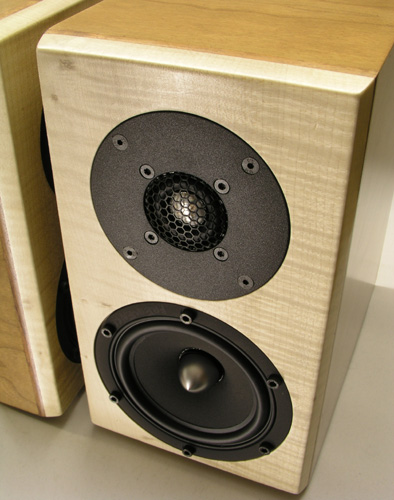
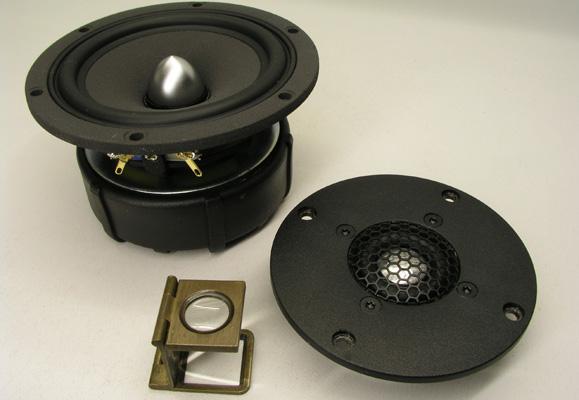
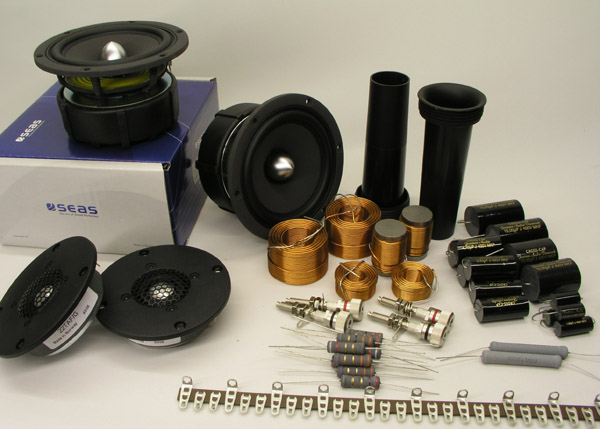
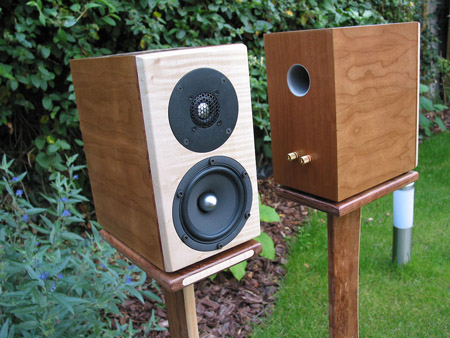
This project is realised in collaboration with John Eekels, Holland. John was asking for a substitute for the no longer available SEAS W11CY001 and after some search we decided to give the new SEAS W12CY003 a try. This driver features a classic paper cone with standard coating on the rear and Nextel coating on the front, giving it a nice appearance as can be seen below. I have previously done a two-way from SEAS CA18RLY+22TAF/G (not published) from which I've had some good times, thus the SEAS 22TAF/G tweeter was the one I wanted to try out in this construction. To my ears the 22TAF/G is doing as well as the HIQUPHON OWI, that's how high I rate it. The small 19 mm alu dome combined with a wide fabric surround seems to combine the best from 3/4" and 1" domes. It may not have the power handling of a well designed 1" dome, but less can sometimes do. So, John shipped his cabs + W12s to Denmark and this really makes life easy for me.....except that I can't keep the speakers once finished. Well, we can't have it all, can we? WAFTEN was a possible name for these speakers, but eventually we decided on Eekels. But WAF-10 is certainly what they are. It doesn't get much better on this important parametre.
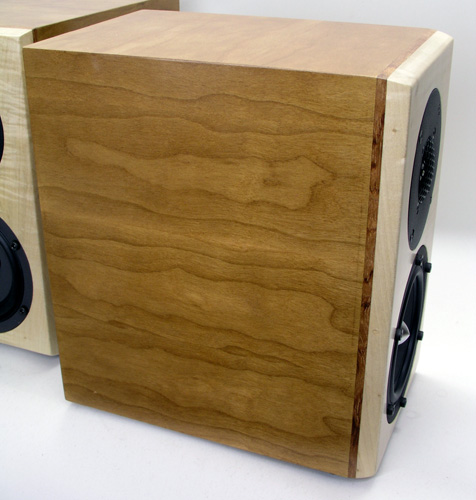
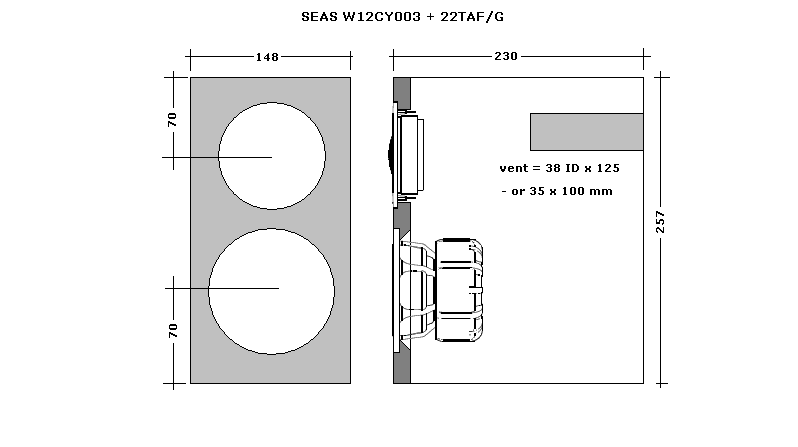
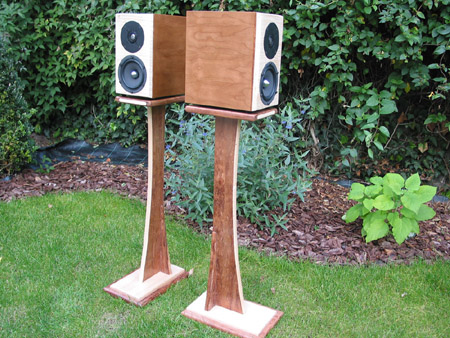
Eekels' cabs are made from 17 mm plywood (incl. veneer). America cherry for the sides and rear, fillets made from African bubinga and front panel from solid curly maple. The dimension leaves an internal volume of 4.8 litres and I suggest a vent tuning of 60 Hz requiring a 35 (ID) x 100 mm vent. Right out of the box the W12 had an Fs of 80 Hz but after some heavy massage ended at ~65 Hz; not unusual for a 4" driver.
Damping:
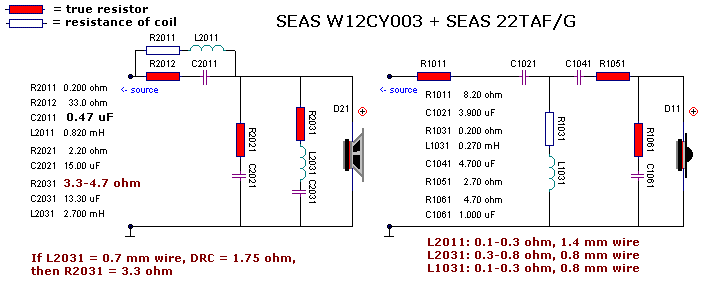
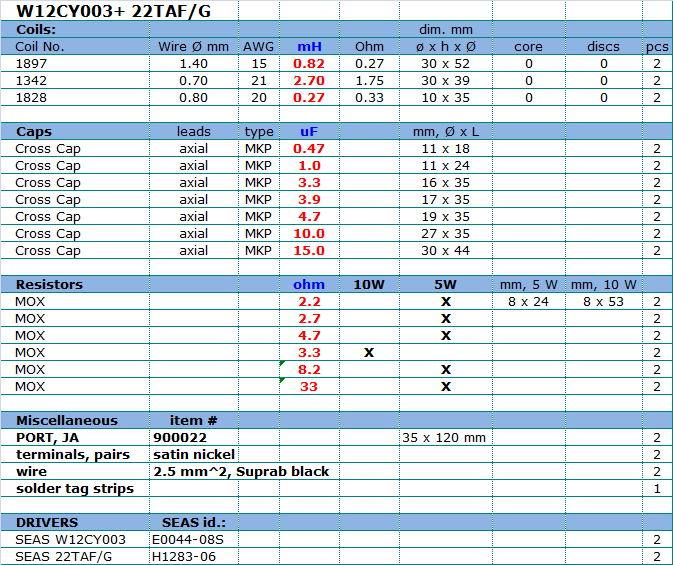
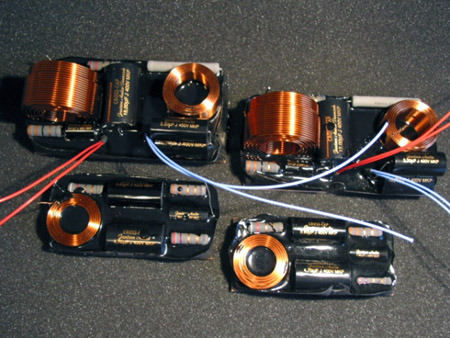
Pay notice to L2031. The combined resistance of coil and resistor should be 4.8-5.2 ohm. Pay also notice to the size of components for this construction. There's not an awful lot of space available for the crossover. I suggest splitting the crossover in two, e.g. bass section on rear panel and tweeter section on top. An immediate up-grade would be replacing C1021 and C1041 with Superior-Z caps, 2 x 3.9 and 2 x 4.7 uF Superior-Z. Consider space when doing so.
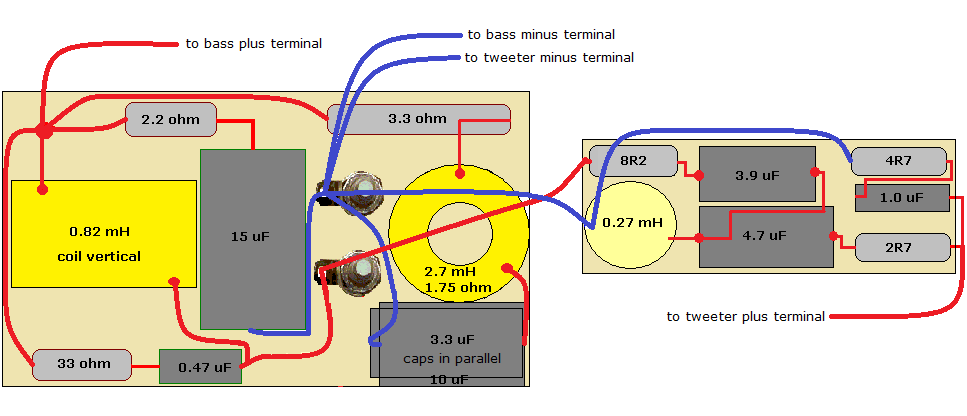
Suggested crossover layout for the Eekels. Bass section on rear panel. Before you mount the front panel and vent, try taking a look at your crossover layout. I've split the low-pass and high-pass section to get the coils as far away from each other as possible. The bass section is some 80 x 130 mm and should be able to pass through the bass driver hole, but check it out before you start poring glue. There are two holes in the bass section for the terminals, so don't drill the holes for the terminals before you have the crossover in place. The tweeter section may be placed on top panel above the vent, so do not drill the vent hole before you have the tweeter section in place. By using the suggested components everything should fit into the tiny cab and not take up too much space. I've been using Superior Z-Caps for testing and this would take another 4 litre box alone for the crossover! But I like an integrated solution and suggest Cross Caps for this application.
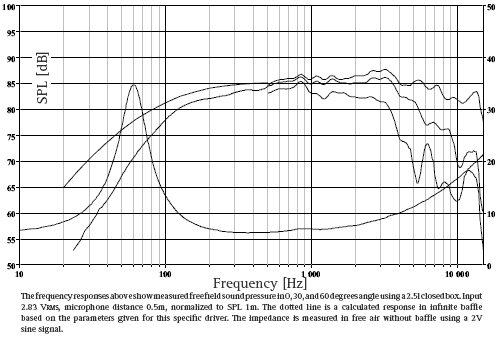
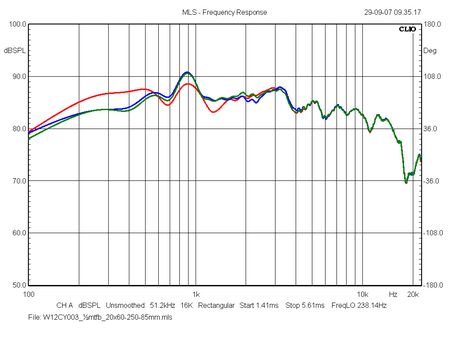
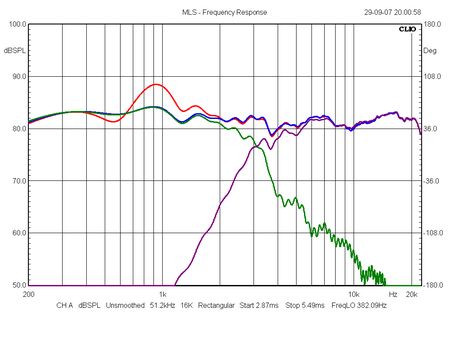
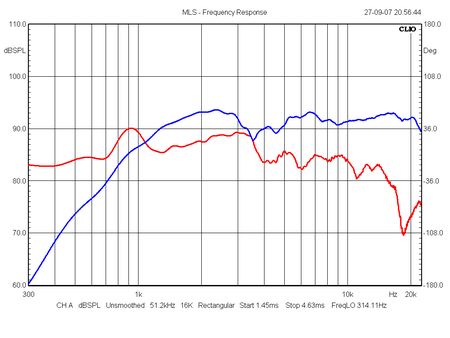
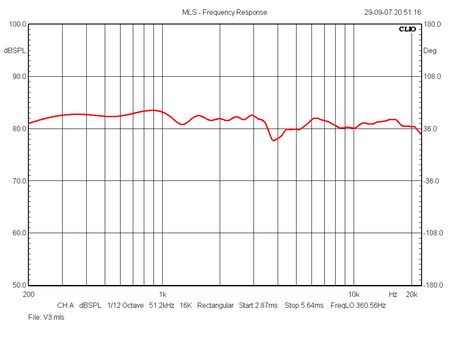
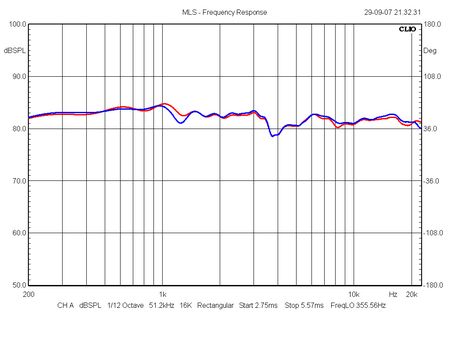
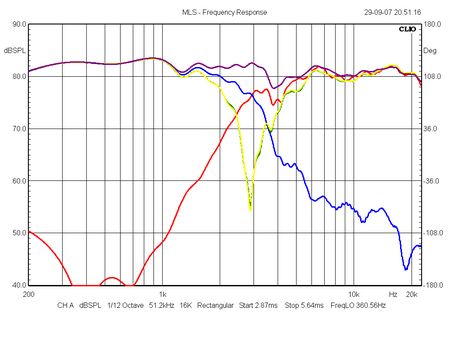
Above to the left: Let's start taking a look at the response graphs from the SEAS data file. Looks really good, doesn't it? Plus/minus 1.5 dB from 500-4000 Hz. Not bad at all. Now, the file doesn't tell the size of the baffle, only the volume of the cab behind the driver = 2.5 litres. So, great expectations..... Right: Red = response on my "infinite" baffle, 60 x 100 cm, wide enough to show what's going on around 800-2000 Hz, the trouble area, where surround resonances usually occur. Well, a 5 dB peak at ~900 Hz was rather unexpected, but playing the W12 fullrange sounded very good indeed and didn't suggest any problems. Mounting any small driver on a tiny baffle is calling for trouble, so I was prepared for having to equalise the upper midrange. Blue and green = the two W12 drivers in the Eekels cabs
The Sound I'm happy to say this is a worthy replacement of the old W11XT speaker. This 4" Nextel driver seems to think it's a 5" driver. Bass lines are easy to follow and I'm surprised how well it handles vocals. Maybe I should try to compare distortion from the W11CY001 and the W12CY003. I think the W12 is simply better. The 22TAF/G is in line
with my other favourite tweeter, the Vifa XT25TG. These
tweeters never cause me trouble. They just play treble
and they never say: Hey, I'm here! Hear how great I am! A
clear sign that something is wrong. Moving the speakers to our living room changed the sound a lot. Driven by my 20 wpc single ended amps the bass level decreased somewhat and the 83 dB sensitivity was not the favourite disc of these mono amps. So, in came my Rotel RB981 150 wpc amp and things changed a lot. If you want to use valves, go for some minimum 35 wpc push-pull design that can handle the low sensitivity. You won't play these speakers to ear-splitting levels anyway, because 50 cm^2 membrane area simply cannot move a lot of air. But again, the bass these speakers can play is really good, even to the point where you can get a certain feel of the bass; that is if your amp can hold the bass driver membranes in a firm grip. I've shown a few people the draft file during construction and as often is the case, expectations are too high. Yes, you can add a sub at 100 Hz and make good sound, but they will never sound like big speakers, because they still have to handle the 100-300 Hz region where so much energy is localised. And don't use them with an electronic crossover at e.g. 300 Hz. You'll still not have a system sensitivity above 83 dB, where a true 3-way from W12s and suitable 6-8 inch bass drivers would easily make 88-89 dB/2.8V. So, be clear on what 4" drivers can do and what they cannot do - and enjoy the music.
Aftermath Hi Troels,
|