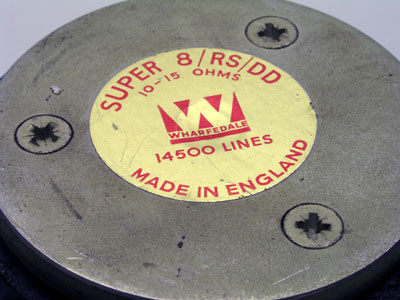
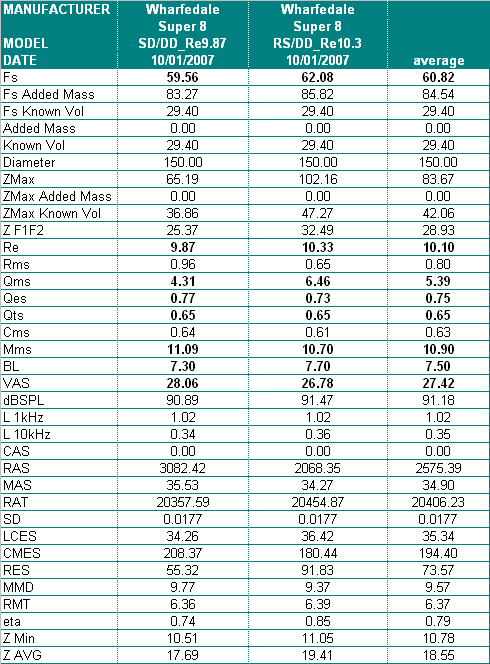
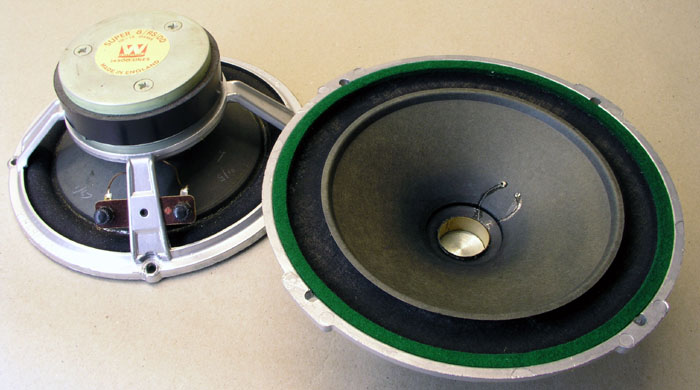
| Wharfedale Super 8/RS/DD, 10-15
ohms Copyright 2007 © Troels Gravesen |
||||
|
||||
| Wharfedale Super 8/RS/DD, 10-15
ohms Copyright 2007 © Troels Gravesen |
||||
|
||||
These
vintage Wharfedale Super 8 drivers were bought
to possibly serve as mid-drivers in a 3-way open baffle
set-up, but before this minor report starts, I have to
tell I have a copy of Gilbert Briggs' book Loudspeakers,
bought in 1971. This is one of the best books available
on loudspeakers and despite several decades old, still
tells most of what is important to know in constructing
dynamic loudspeakers. Being 19 years old back then, I
desperately needed basic information on loudspeakers and
this was my speaker bible for many years, and still is
today. Who can write a book on loudspeakers spiced with
wise philosophical quotes without being corny? Gilbert
Briggs can, but dear Mister Briggs in Heaven (I believe
you are there), how on Earth could you release a crummy
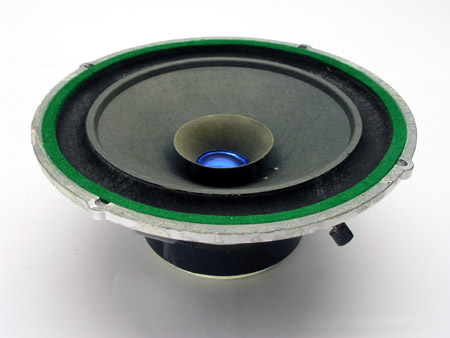
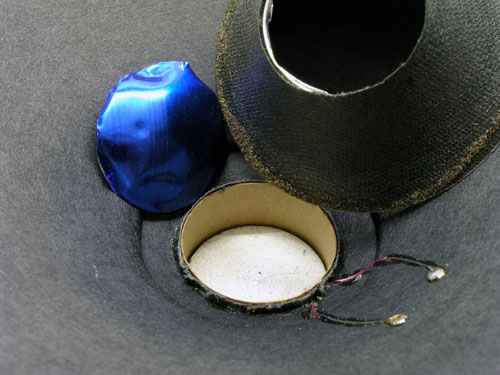
driver like this? I can forgive you the green felt ring
and awful blue alu dome fitted to the whizzer, both
probably meant to catch the eye, but all in all, this is
probably the worst driver I have ever had, and here is
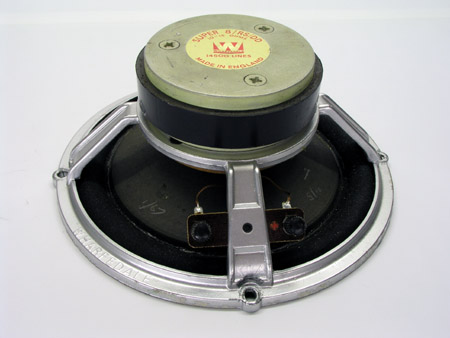
why. Read mail exchange with former Wharfedale employee here. The Super 8/RS/DD is in many ways
a modern driver. A highly ventilated chassis houses the
straight-sided paper cone attached to a voice coil wound
with aluminium wire. Not many did that back then, because
soldering the copper litze wire to the alu wire wasn't an
easy thing to do and it took an ultrasonic bath to get
rid of oxidation before the solder would bite. The driver
has an excellent ceramic magnet system ensuring lifelong
performance. So does the fabric surround if kept away
from mice and termites.... But back to the cone and the
surround, because this is where the trouble originates.
The straight-sided cone, voll-konus as the
Germans would say, has some great properties when it
comes to working pistonic - up to a certain point. Beyond
that, it breaks up like crazy and rings like a bell. For
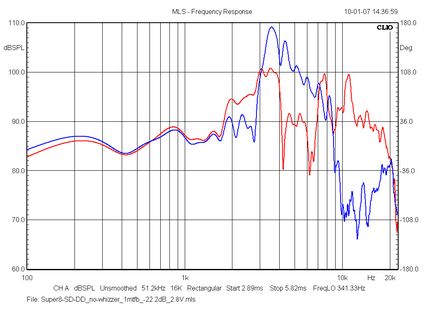
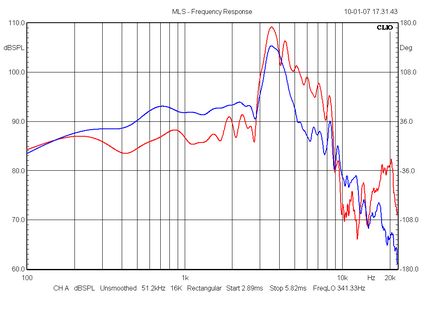
this driver it happens around 3 kHz and all of a sudden
the amplitude rises some 15-20 dB above average level. A
gigantic peak is the results and there's not much we can
do about it. Well, Briggs added a whizzer cone and maybe
that was the best thing he could do, because the whizzer
cone makes a terrible mess in the 3-8 kHz range and to
some extent smears the nasticies by producing a deep dip
from 4 to 7 kHz. To further dampen the peaks, a polyester
foam strip was added outside the whizzer cone. This foam
ring simply disintegrated by touching, being probably
more than 40 years old.
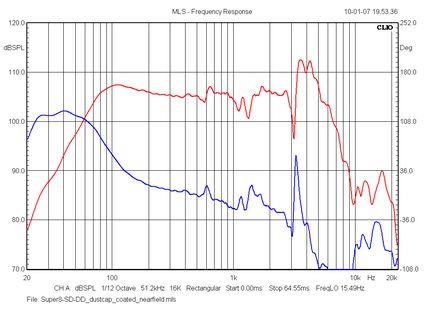
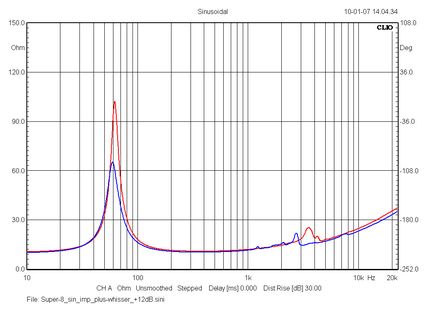
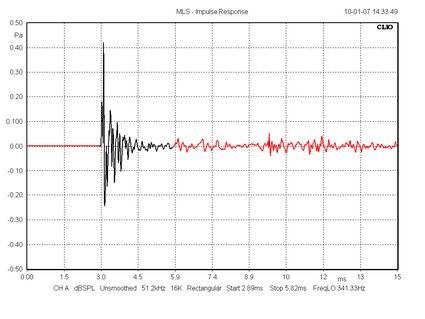
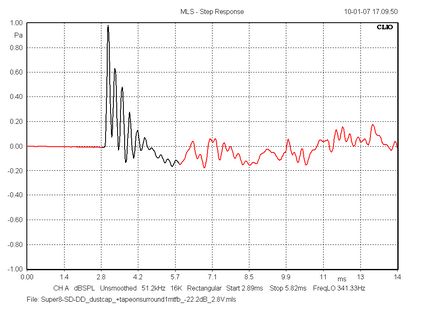
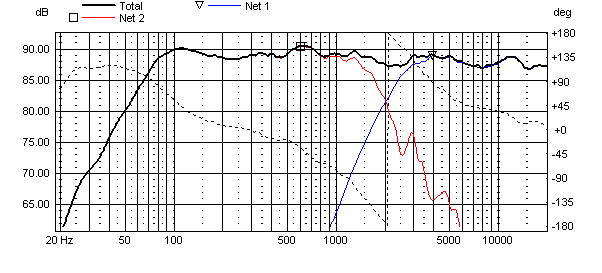
Left: The red graph above is the Super 8 as-is. Severe peaks at 3-4 kHz and 7-12 kHz. The blue graph is from removing the whizzer cones. Now the peaks are at least concentrated between 3 and 9 kHz, but what a peak! Right: I usually don't show nearfield measurements, but here's one. 32 ms window and 1/12 octave smoothing. It's a rare thing to view such a smooth response from 100 Hz all the way to 3 kHz. The blue is minimum phase and display the severe phase-shift at 3 kHz where all of a sudden, things starts getting out of control. The poor thing rings like a bell as can be seen below from the impulse and step response graphs.
Well, the Super 8 was intended for an open baffle system using low-order filters, but I'll have to source other options. Mail: 09-05-2009: I was employed as a technician by the
Australian import agents for Wharfedale spkeakers;Simon
Gray P/L., inthe '60's. I can confirm that the
photographs of the referenced speaker shown on your
website are indeed that for that model and date i.e. 1/67
as clearly marked on the cone. Later models
differed only in that a black Paint was used on the
aluminium dome instead of the translucent blue coating
and a slightly modified frame. There were many assembly
problems with this model in the Rank/Wharfedale era
caused by increased production demand. The coil and
former required additional coating (doping) to
fully bond the coil and to stiffen the paper former.The
cloth roll surround was rarely fully sealed and leaked
air.The stepped cone was not a good choice as it was
intended for the U.S. market which sought a higher power
handling capacity i.e. a 1.5'' voice coil version.
Often the aluminium dome was not fully bonded to the
tweeter cone causing odd distortions if not buzzes. After
a few years the black rubber sealant dried out causing
the the surround to stiffen. The suspension then
became non- linear as the roll rather than the corrugated
disc spider controlled the restoring
force.
Barry M. Arnstein. Dear Barry, thanks for the additional information. This makes a lot of things fall into place. Best regards, Troels. |