The
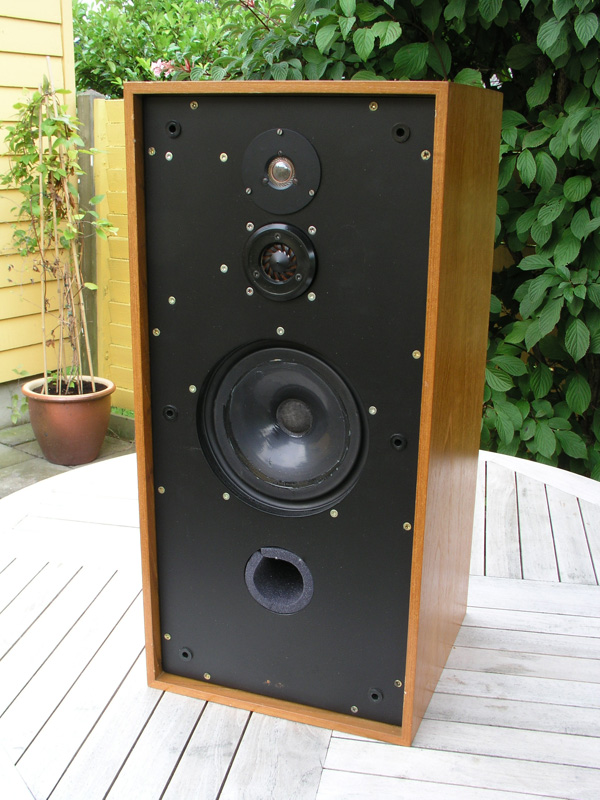
Spendor BC1 is basically a three-way system with
points of crossover around 3 kHz and 13 kHz.
"BC" stands for Bextrene cone Celestion
tweeter, according to Ken Grey, former Spendor employee.
The midbass is a small 8" driver fitted with a
bextrene cone and an inverted rubber surround, in fact
quite similar to the KEF B200, SP1039. From 3kHz the
Celestion HF1300 tweeter is taking over and runs up to
its intrinsic upper limit around 13 kHz from where it
rolls off steeply as can be seen from the graphs below.
To help in the top octave, a Coles 4001 super tweeter is
used; a small 3/4" tweeter fitted with a plastic
dome. The 4001 super tweeter has a 23 ohms DC resistance,
quite unusual. Generally the DC resistance of all drivers
is high, making this speaker an ideal partner for valve
amplifiers.
Overall I find the BC1 a
very well executed loudspeaker construction. The use of a
thin-walled plywood cabinet has its pros and cons and is
not solely responsible for the BC1's somewhat un-precise
bass response. The bass driver's Qt is too high for a
ported construction and even a larger closed box doesn't
leave things ideal. This driver simply needs more magnet
strength. On the good side the midbass delivers an
excellent midrange and the transition to the Celestion
HG1300 tweeter is indeed very well done.
I find the voicing too bright for my taste, but this may
easily be adjusted by adding a little attenuation to the
HF1300 tweeter.
A large amount of information
on this speaker is available on the web.
To get an idea of performance I suggest you read the
review by Bob Neill of the current Spendor SP1/2 compared
to this old classic: http://www.enjoythemusic.com/magazine/equipment/0302/spendor12.htm
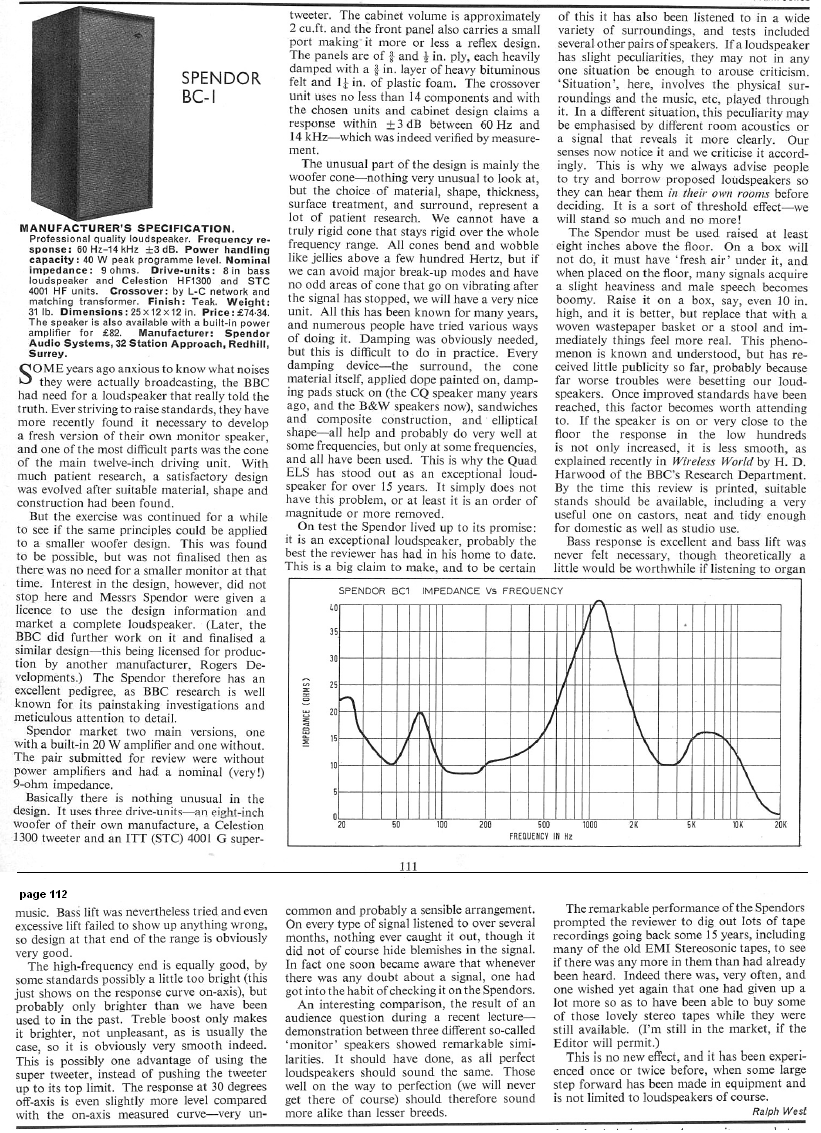
Read review of
BC1 in "Hi-Fi News & Record Review Annual
'73". 500 KB, Thanks to Darryl, for the scan.
Also read Hi-Fi News,
November 2005, page 66-69. Ken Kessler on the BC1.
Also check out this website: http://spendor.de/warum.html
BC1 cabinet
BACK
TO INDEX
 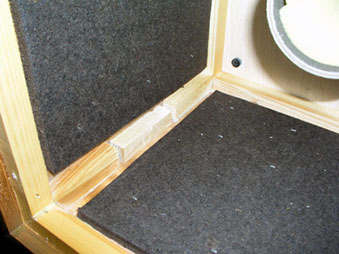
Cabinet
data:
Dimensions: 300 x 300 x 637
mm (HxWxD). Internal volume approx: 38.4
litre.
Front panel:12.3 mm Baltic birch.
Rear panel: 12.3 mm Baltic birch.
Side panels: 10.5 mm Baltic birch
including veneer.
Bitumen pads on internal panels: 10-11
mm lightweight bitumen impregnated masonite (wood fiber).
Damping: polyester foam on all internal panels except
front panel, 30 mm thick and relatively
light weight.
Front grille frame is made from 6 mm plywood and frame
fillets are 40 mm wide. On the outside
is added 7 mm polyester foam below the
fabric.
Vent: 75 x 125 mm vent is added a sheet
of polyester foam: 15 mm thick, thus the
vent appear to be 45 (diameter) x 125
mm long
Port tuning: 28 Hz (see impedance
measurement below)
The first time you open the BC1
cabinet and find out the cabinet is made from 10
mm Baltic birch, you start wondering what is going on
here. The panels being this thin, you'd expect some very
heavy bitumen pads to be glued to the panels inside to
move the panel vibration modes down in frequency. Not
here. The bitumen pads are approx. 11 mm thick and made
from some quite lightweight wood fiber material, which in
Denmark would be referred to as "soft
masonite".
BC1 crossover
BACK
TO INDEX
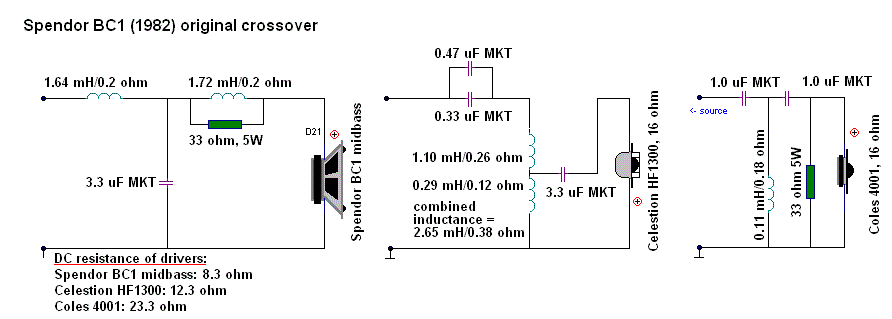
BC1
crossover schematics. Third order for the midbass. Third
order high-pass for the HF1300; no low-pass filter for
the HF1300.
Please note the HF1300 is connected with inverted
polarity.
This tweeter rolls off steeply from above 13 kHz. HF1300
attenuation is achieved from a tapped inductor.
Third order for the super tweeter. If anyone has other
BC1 schematics I'm interested.
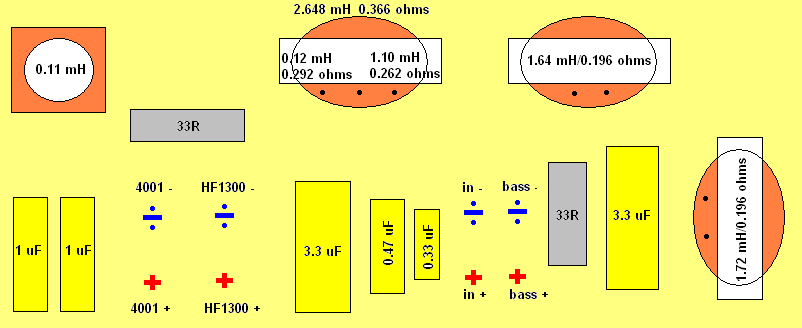
Crossover
layout.
HF1300 + goes to tweeter minus (black terminal)
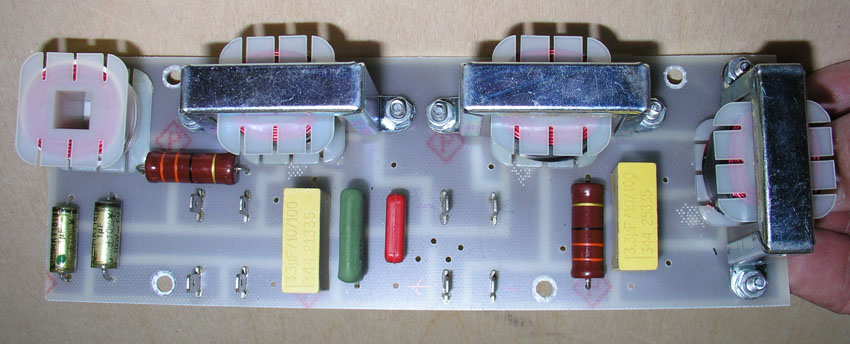
BC1 crossover board.
Measurements
BACK
TO INDEX
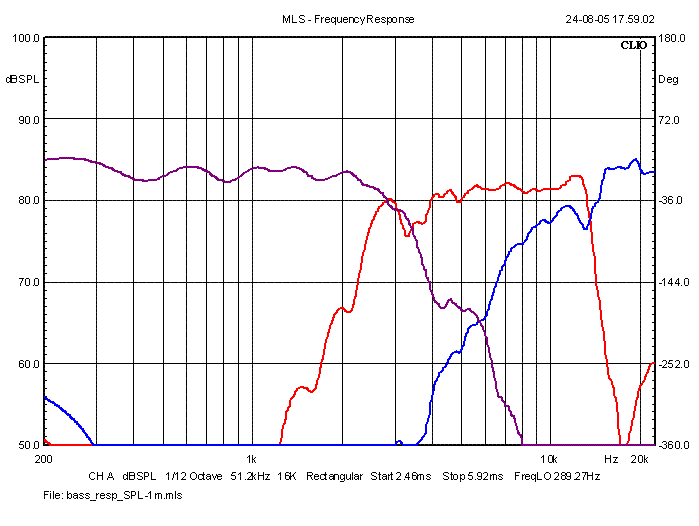
Frequency response of
individual drivers driven from crossover. The
midbass in an example to follow. HF1300 tweeter
has a dip at 3.5 kHz - or is it a bump at 2.5-3
kHz? Read below.
The Coles 4001 super tweeter does have a lot to
say in the upper treble region despite a 3rd
order crossover around 13 kHz.
|
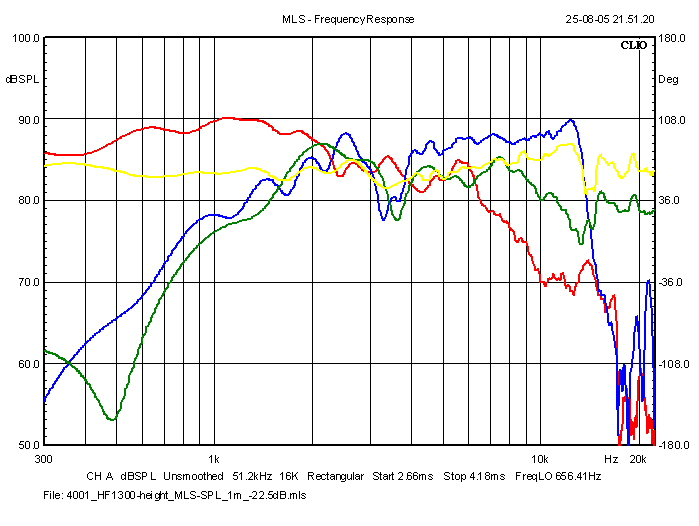
Frequency
response of individual drivers measured
at 1 metre distance. Red = midbass, blue = HF1300
tweeter, green = Coles 4001 supertweeter. Yellow
= combined response with crossover.
The midbass
displays an overall smooth response with no
serious cone break-ups.
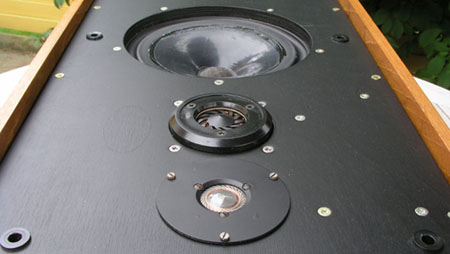
HF1300 tweeter has a deep dip
around 3.5 kHz, which is caused by the cabinet
lips protruding some 15 mm in front of the front
panel. See graphs below on HF1300 response from
flush mounting.
Coles 4001 (green) seems to have
a much too low response to be able to level with
the other drivers and I'm not sure why there is a
discrepancy from the responses with and without
crossover attached. I'll have to repeat these
measurements to see what's going on. The 4001 has
a 23 ohms DC resistance, which counts for its
apparent very low sensitivity.
The combined response
of drivers with crossover connected is remarkably
flat. This speaker is more than 20 years old and
still has a plus/minus 1 dB frequency response in
the entire midrange and up 3 kHz. Excellent! The
HF1300 is basically flat with a slightly raised
level up to 13 kHz. Had the 4001 supertweeter not
been placed near to a 15 mm cabinet edge fillet,
I believe the response here would have looked
better.
|
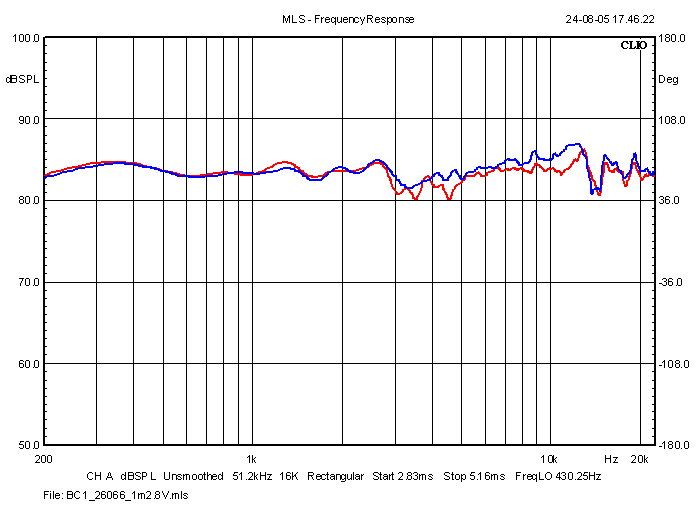
Frequency
response of individual speakers. This is an example to
follow, a truly matched pair of speakers.
The difference in response throughout the midrange and
lower treble is as low as can be.
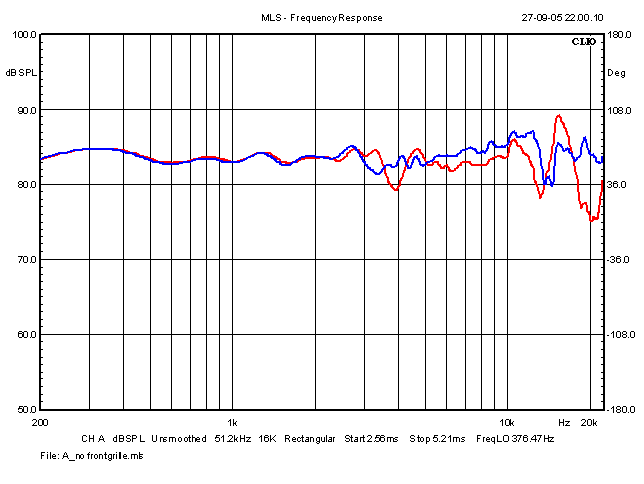
Frequency response plus/minus front grille. Red = incl.
front grille.
I cannot help admiring how remarkably flat the whole
midrange, lower and upper treble is from this speaker.
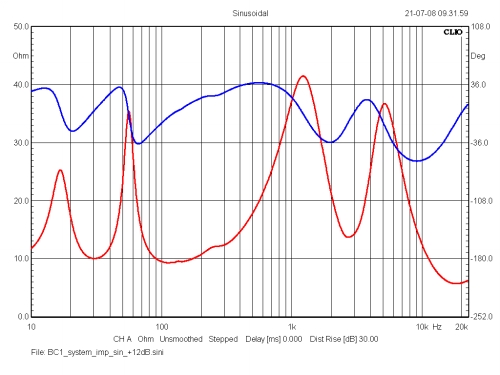
Impedance of system as-is, i.e. port with foam lining.
This picture differs a bit above 3 kHz
compared to the HiFi-News profile seen below. There may
have been changes to the tweeter
crossovers along the way. With a minimum impedance of 9
ohms and modest phase angles,
the BC1 is indeed a valve friendly speaker - that is, if
we're not talking 5 watt SET -
or even 10-20 watts SET. 35 wpc PP amp seems more like
it.
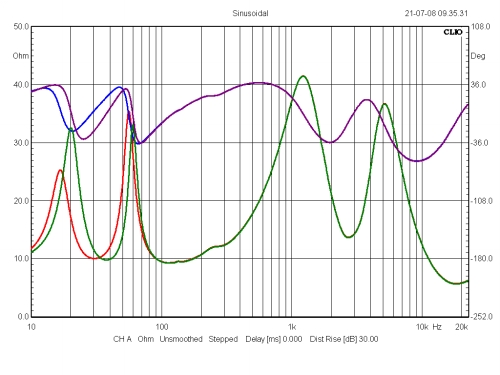
Impedance +/- foam in vent. Green = no foam.
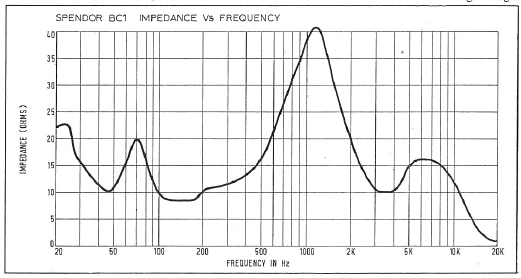
HiFi-News impedance measurement for comparison.
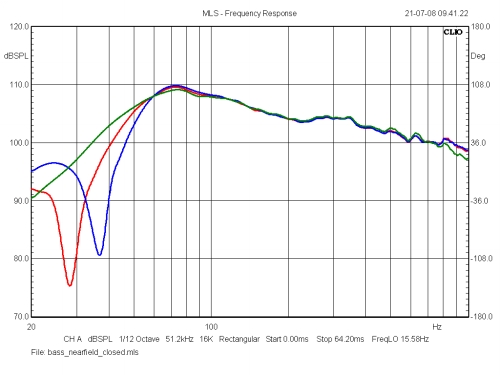
Nearfield response of bass driver. Red: as-is, blue = no
foam in vent. Green = closed box.
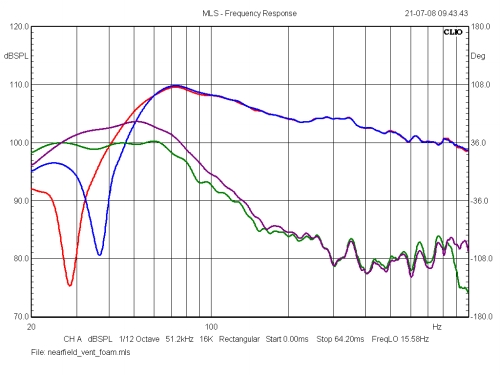
Nearfield response of bass driver with foam in vent (red)
and no foam in vent (blue).
Purple = nearfield response of port with no foam in vent,
green = with foam in vent.
The port response is remarkably free of any peaks higher
up in the midrange. Quite unusual.
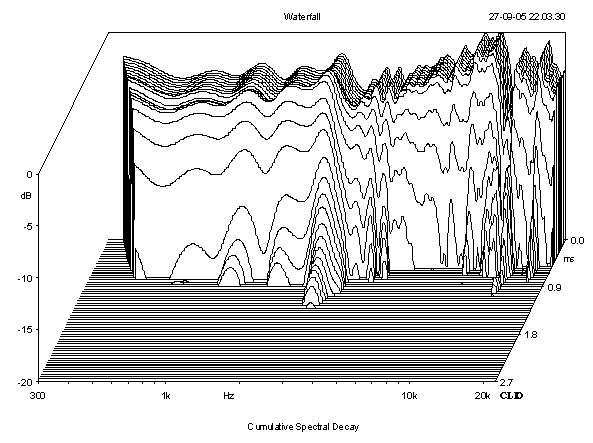
CSD, cumulative spectral decay. The midrange is an
example to follow in terms of lack of resonances.
The "shoulder" at 2.5-3 kHz is derived from the
HF1300 and something is going on around 13 kHz
too where the HF1300 crosses over to the Coles
supertweeter.
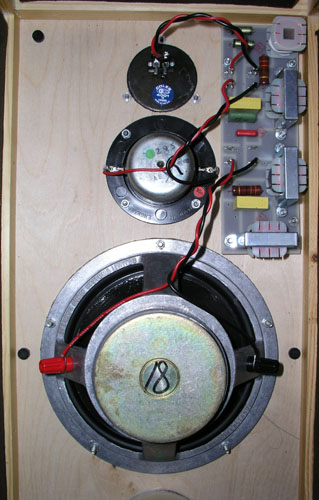
Spendor BC1 interior.
Very rare to see such a degree or order and
overall quality design. There may be minor
improvements from up-grading crossover
components.
Everything in this design appears well
considered. There are no resistors in series with
any of the drivers. Tweeter attenuation is
achieved from a tapped inductor. However, the
tapped inductor only has one outlet, thus, you
are stuck with the chosen degree of attenuation
and the overall balance of this speaker is fairly
bright - to my ears.
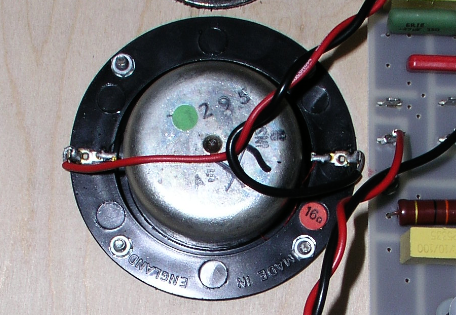
Note tweeter wiring, red goes to minus.
BC1 tweeters
BACK
TO INDEX
Coles 4001 supertweeter
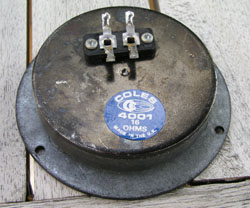 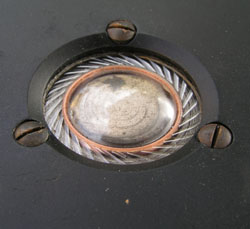 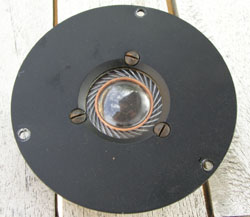
| Coles
4001 supertweeter. I still have to measure this
fellow flush mounted on a panel without 15 mm
cabinet edge fillets in the neighbourhood. The
wires from the voice coil are extremely thin and
I did not dare unsoldering the wires from the
soldering tags on the rear to remove the
diaphragm and add a thin felt pad on the
polepiece. I wonder why this driver has a 16 ohms
rating having a DC resistance of 23 ohms. |
Celestion HF1300 tweeter
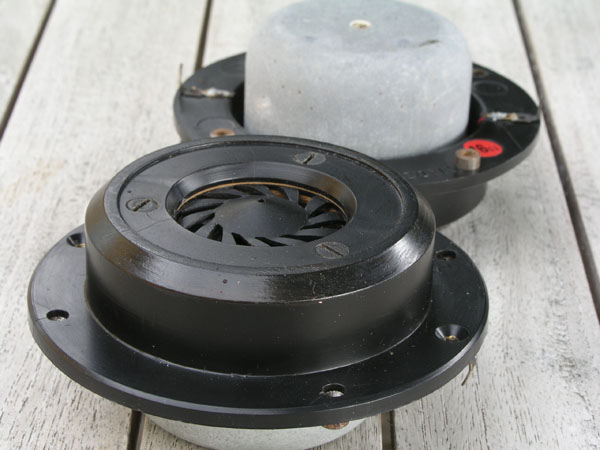
I've
never seen a tweeter like this one before. It has a
rather high resonance frequency:
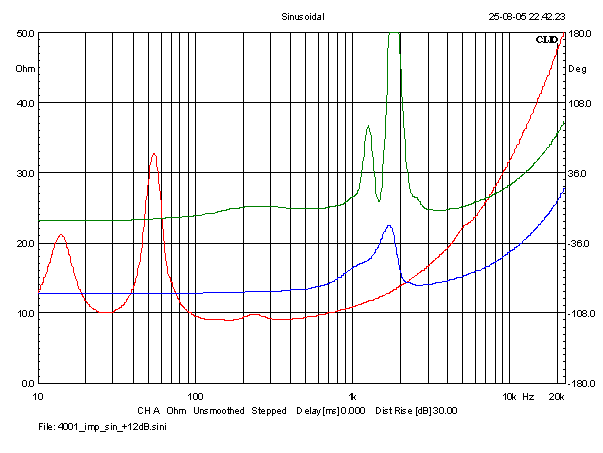
Impedance
of drivers in cabinet. Red = BC1 midbass, blue = HF1300,
green = Coles 4001.
The Coles has an impedance around 23 ohms!
Generally all drivers have a high impedance profile; good
for valve amps.
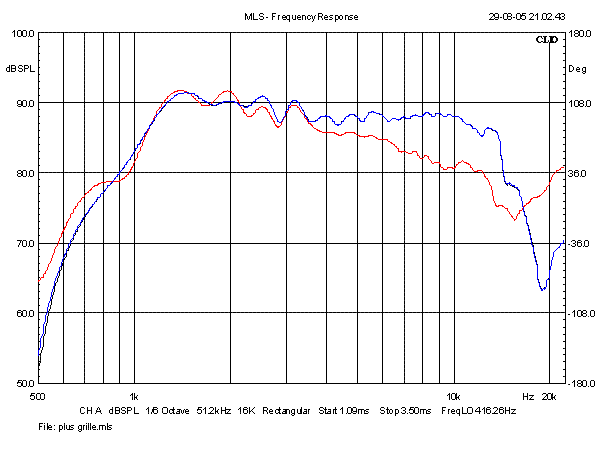
HF1300 plus/minus "turbo" grille. It's quite
remarkable that the grille is able to focus the energy
the way it does.
Red = minus grille. Blue = plus grille.
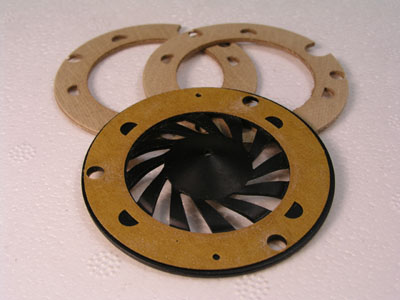 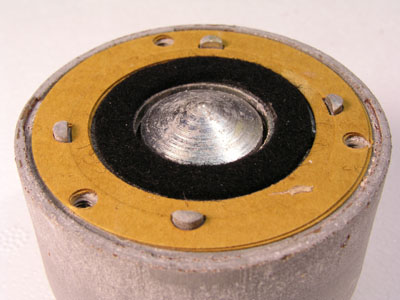
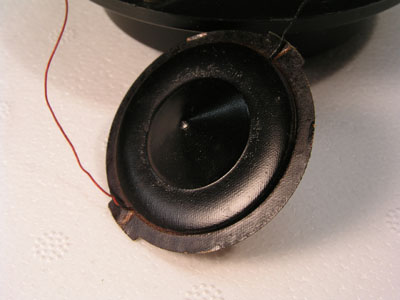 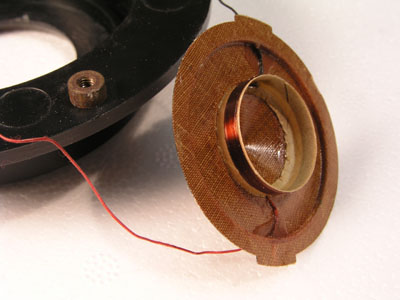
Above the HF1300 disassembled. The diaphragm is some
resin impregnated fabric material with a very rigid
suspension.
The suspension is very wide and a similar feature is seen
on modern tweeters by Vifa and SEAS.
I recently came across a
description of this tweeter in Martin Colloms' excellent
book "High Performance Loudspeakers", page 219:
"An
unusual and highly successful example of a hard dome HF
unit is undoubtedly the HF1300 family, manufactured by
Celestion (UK). Variations of this design has been
produced since the mid 1950s, and have been used in a
number of systems. Almost all of the details of its
construction have proven to be critical, these range from
the particular grade of cured phenolic impregnated fabric
used for the diaphragm, to the spacing of phase
correction plate. The centre dome is conical, about 19 mm
in diameter, and has a shallow, rather broad surround
actually larger in area than the dome itself. The unit as
a whole has an overall diameter of 38 mm. The surround is
in fact the main radiating element; the piston operation
holds to be beyond 15 kHz and the diaphragm is
particularly free of hysteresis effects. This, in
conjunction with its relatively uniform axial frequency
response, accounts for its unusually favourable
subjective qualities.
The diaphragm's intrinsic pressure characteristic shows a
peak at fundamental resonance (1.7 kHz), which is damped
by restitively controlled air vents to the cavity within
the closed magnet. The centre pole has a conical profile
to closely follow the contour of the underside of the
dome, this placing the first rear standing wave mode at a
very high frequency. The output of the naked diaphragm
falls above 7 kHz or so, and to correct this a perforated
front plate is fitted, formed so as to follow a similar
contour to that of the diaphragm. This results is a
damped resonant cavity loading the diaphragm, and also
provides a delay path between the dome and the surround
radiation. The output is uniformly maintained on axis to
14 kHz. Good examples may demonstrate a +/- 2 dB
characteristic from 2 kHz to 14 kHz, with a range 4-12
kHz held within +/- 1 dB."
Great! Finally a thorough explanation on
how the HF1300 works. The purpose of the phase plate is
well demonstrated in the FR graphs above.
More info on the HF1300 from J.
Bright in Australia.
"Love
the site especially the vintage and British Spendor
stuff. I have a pair of HF1300 and I have some additional
information. As I understand it they were originally the
'compression' driver for a horn loaded treble unit. This
was to be used with a very early METAL coned unit
(8"?). It was around the mid 1950's and it was
produced by GEC and the designer associated with was a
person called "Brittain", I think, but I'm not
absolutely 100% clear about this, but I have a pretty
good memory. I used to own a copy of Gilbert Briggs book
"Loudspeakers" (5th edition 1958) and there is
clearly an early HF1300 in a photo of a collection of
tweeters and I am pretty sure it is identified as "A
GEC pressure unit". I guy in England called Royal
told me that the tooling for the HF1300 was sold by
Celestion to Coles who also now make the 4001 after
presumably buying the rights for them from STC. If you
are into speaker trivia the following might interest you
also. I believe the 4001 super tweeter began life as the
diaphragm in a STC microphone! You'll find both the
tweeters on the Coles Acoustics website but they have
developed a new metal mounting plate for the HF1300. But
I'm sure it is the same mechanism behind the front frame.
I also have some data and a paper on the 4"
Jordan-Watts modules (I own a pair). I'll send you a copy
if you are interested."
Thanks
a lot for the info from Mr. Bright.
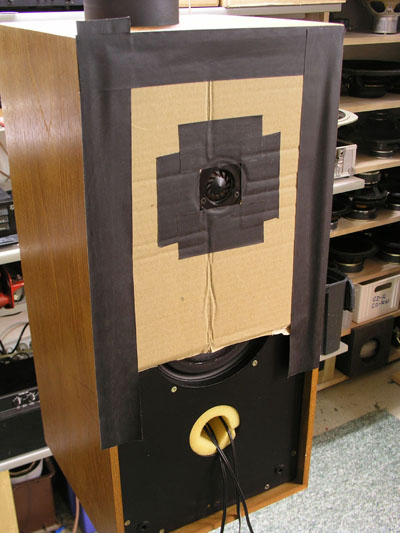
Flush
mounting of HF1300 by a simple piece of cardboard.
This improves the SPL response significantly. See below.
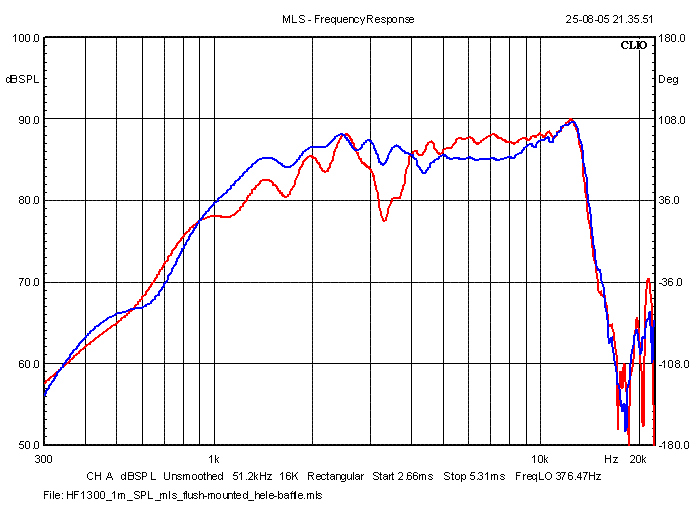
Red
= "as is", blue = flush mounted driver.
Sometimes you wonder about the design criteria behind a
certain set-up.
The dip at 3.3 kHz would be visible also with the
measuring equipment used at the time of construction.
BC1 midbass
BACK
TO INDEX
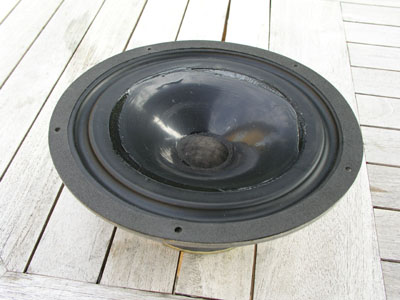 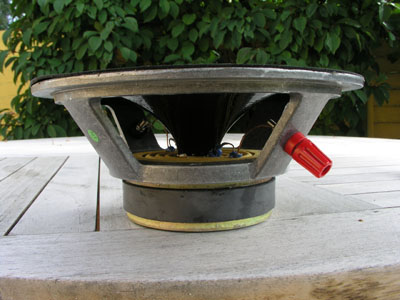
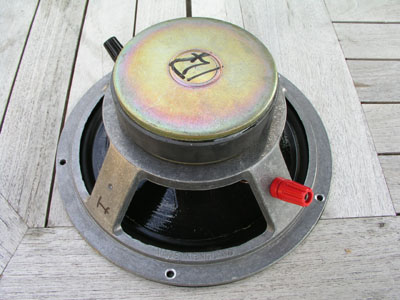 
BC1
midbass driver. A small 8" driver fitted with a
bextrene cone applied a decent amount of coating to both
sides.
This driver has a ceramic magnet where older types would
be fitted with alnico.
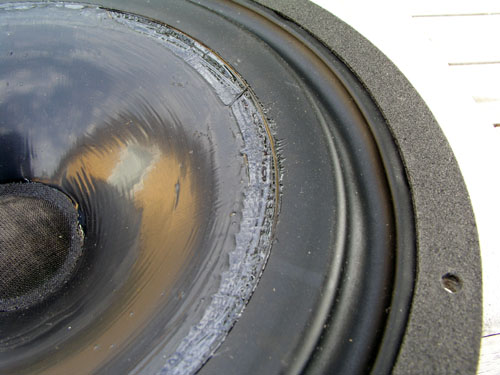
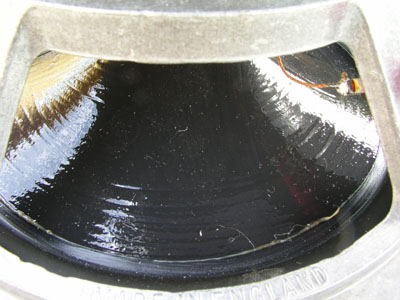
The coating applied to the midbass
drivers has been repaired on both drivers. I think the
only long-term problem with the BC1 speaker is the
midbass coating starting to peel off due to use, sunshine
or whatever.
However, the coating on the rear of the diaphragm is in
perfect condition and on the front it has been repaired
with some slightly sticky stuff that may actually be
better suited for the front, being more flexible than the
original coating. Whether a new coating may produce the
same result as the old coating is very unlikely, but in
this case it's only some 2-8 mm along the rubber surround
and from the SPL readings taken on the bass driver alone,
there does not seem to be anything abnormal going on.
I'm pretty sure it's impossible
to get the formula for the coating used on the drivers.
So, if you are looking for a BC1 speaker, require some
very good and sharp photos of the driver membranes near
to the rubber surround. On the web I've seen the
suggestion of the BC1 midbass driver being replaced by a
Vifa 8" paper cone driver, but I would never do
this. This is likely to totally change the sonic
character of the BC1 speaker. Not even a polypropylene
driver may come near this driver. Not that it necessarily
would be worse, but only different from how the BC1 was
intended to sound.
May
2021:
Thanks to Hans-Martin, Germany, I now have this information on
coating (and additional information):
Today I want to give you something in return:
https://worldradiohistory.com/UK/Wireless-World/60s/Wireless-World-1968-04.pdf
@ printpage 117 (PDF pages 114-118) it reads:
"As already mentioned, the bass unit
employed is the 305mm
plastic cone unit described last
month. A chassis with a more
powerful magnet is
now available and an increase in sensitivity
of about 2 dB
is thus possible. Further experience with
the
unit revealed a slight colouration
in the 1.5 kHz region,
and this is accentuated
with a later material manufactured as a
replacement for
the type of Bextrene formerly used.
It is
however completely removed by
painting the cone with a
layer of
polyvinyl acetate damping
compound known as
Plastiflex type 1200
P, even though
this treatment does not
cause any
appreciable change in the frequency
response."
....
" Listening tests, however, showed a
noticeable colouration in the 1.5 kHz
region and chopped -
tone tests were
therefore applied. In the region 1.2
kHz to
1.7 kHz these tests revealed
three resonances with Q- factors
of the order of
500, some 40 dB below the steady
-state con-
dition. If in phase with
the steady -state condition, these
resonances
represent irregularities of no more than
0.1 dB
on the axial curve and
can only therefore be measured by
chopped -tone techniques. It was however
shown that the
application of a layer of
Plastiflex type 1200P damping corn-
pound to both sides of
the cone reduced the resonances to a
marked
extent; furthermore, the use of pink noise
and the
recording technique mentioned for the bass unit
demonstrated
a great improvement in the reproduction and
the colouration
was reduced to a very low
level. "
polyvinyl acetate
PVA aka wood glue....
The citated article actually refers to the making of BBC LS5/5
The series starts in
https://worldradiohistory.com/UK/Wireless-World/60s/Wireless-World-1968-03.pdf
and ends :https://worldradiohistory.com/UK/Wireless-World/60s/Wireless-World-1968-05.pdf
(pages 92-95)
(pages 66-69)
Another article
http://downloads.bbc.co.uk/rd/pubs/reports/1967-57.pdf
tells:
" The cone was coated on both sides with Plastiflex 1200P to
reduce slight colouration in the 2 kHz region and in this regard
listening tests show that the reproduction from the coated unit is
remarkably "clean"."
Another article
http://downloads.bbc.co.uk/rd/pubs/reports/1969-05.pdf
tells:
"There were, however, some signs of a lower-middle colouration below the
frequency at which the 200 mm unit is used in the LS5/5. Treating the
cone with a second layer of p.v.a. Plastiflex type 1200P removed the
colouration without seriously affecting the response/frequency
characteristic; "
Spencer Hughes and HD Harwood used PVA as
coating at the time when BC1 was designed
Best regards
Hans-Martin
TS-data:
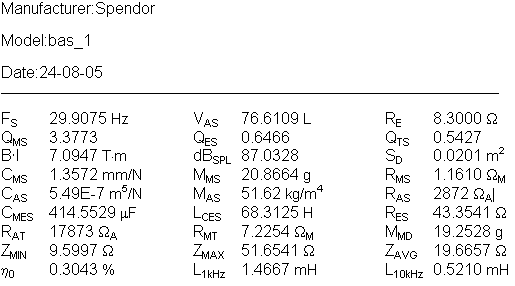 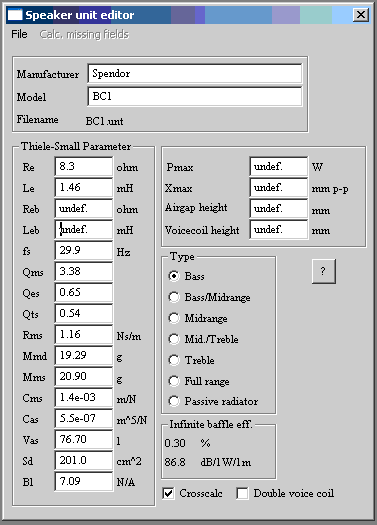
Left:
TS-data for one of the BC1 midbass drivers.
Right: Measured data seems well in accordance with data
generated from crosscalc in LspCAD.
Box
Simulation
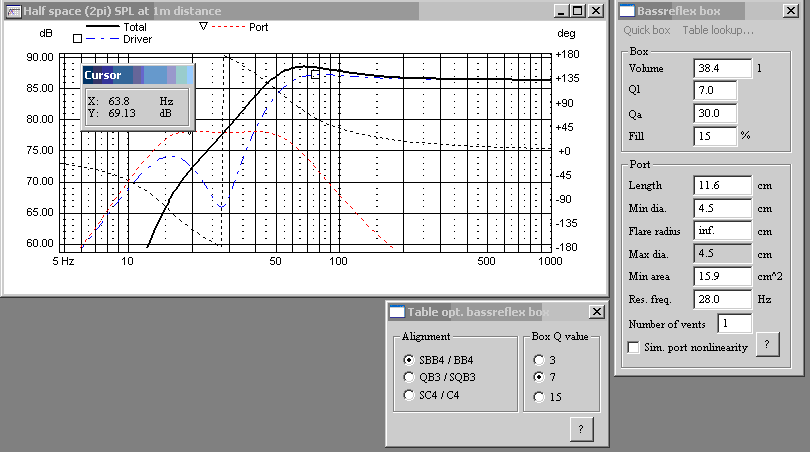
Well, this driver is not particularly well suited for a
vented cabinet.
From pure math a BB4 cab of 105 litres is suggested.
Won't work.
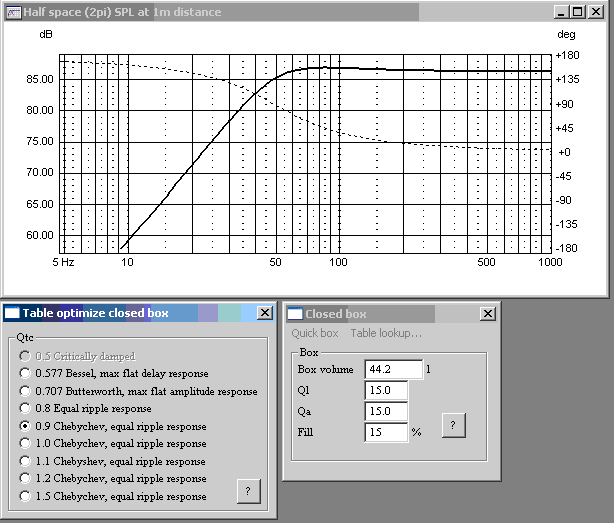
Not even a closed cabinet is easy:
0.707 Butterworth = 111 litres
0.8 Equal ripple response = 66 litres
The 38 litres cabinet with the vent closed will provide
an approx. 0.95 Chebychev tuning.
|